Story provided by parent.
2008 through Present
Parent took her 6-year-old son (on the autism spectrum) to school around 9AM after taking him to the doctor for an earache. Parent walked him to his class and explained to two of the paras that he didn't feel well and had an ear infection. Parent also explained that she wasn't sure if he would make it all day or be able to attend a class party, but if there were any problems at all to call her. Parent called to check on her son at 11:30 and he was fine. At 12:11 the school called and asked parent to come right away.
When parent arrived at the school, the school police officer’s car was parked out front and she could hear her son screaming from outside. She got to the door that leads to the secretary’s desk, which is next to the window where another parent was signing her child out of school. There was a teacher at each arm of her child and the police officer at his feet. Parent walked in and picked up her child. His teacher went to get his things from his class and parent and child met her down the hall. The boy was holding his back crying and his teacher said "Well he did have some red spots on his back".
Parent returned home with her son, questioning him for information. She asked what happened and why he got so mad. The boy said they were being mean, and when asked who, he replied that it was the teachers. Parent asked for clarification and her son stated that he was made me set outside and he was cold. When asked who was outside with him, he replied nobody. With further questioning it became clear he was made to sit outside of the classroom trailer by the door, alone, for a “time out”. Because he was cold, the boy asked for his coat and they wouldn't let him have it
When parent and son arrive home, she looks at his back only to discover that he has carpet burns. Both parents decide to take the child to the emergency room to make sure there are no serious injuries. Parent contacted the Department of Children’s services and parent and child met with representative at the local office. The investigator left a message for the superintendent--the school chose to conduct its own investigation and Children’s Services is not doing a report.
A couple weeks prior to this the boy was restrained because he was hungry, and when parent went to pick up child he kept holding his neck. He had a red ring around his neck where he said they had been pulling on his hoody.
This family has have been struggling with this since the beginning of the child’s kindergarten year—parent has not seen a functional behavioral assessment although the school says one has been in the works. He was restrained all of the time and parent had to pick him up half way through the day almost every day. The last six weeks of his Kindergarten year, the boy was home bound and a teacher came to the house THREE hours a week. During that time the parent got the medication evaluation that the school had requested and hoped that he child could attend summer school; however, they wouldn't allow him to. The family started this year out hoping for a better year but thus far it hasn't been.
At the beginning of the school year parent requested a copy of his behavior record from last year and the beginning of this one, and there were only two things in his record from last year even though he was homebound. Although parent had been called to the school nearly everyday the first two weeks of school only one thing had been documented. A note from the teacher reads that the child had two tantrums after not complying with directions and was restrained both times for 45 minutes each instance. That same afternoon the note reads that the child had to be held/restrained in a chair because he kept tearing his spelling work that they were doing. After completing his spelling he lay down and slept about an hour. The student has an individualized education plan, but there is noncompliance.
Updated: Parent was requested to sign a blanket consent to allow anyone to restrain her child. SHe did not sign. The child is continuing to be restrained weekly, if not daily, for noncompliance issues. Parent has walked in on child being restrained face down on floor with large teacher laying on top of him.
Showing posts with label Testimonies. Show all posts
Showing posts with label Testimonies. Show all posts


Perpetuating the Stereotype of a child with a Disability: Dangerous Child? Explosive Child? Imminent Harm?
Letter from Superintendent:
From Time-out Procedure provided in 2008:
These are two of the seclusion room incident reports that I was given once I knew to ask for them (names of staff removed for privacy).

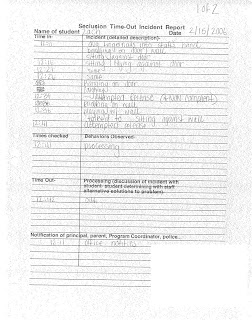
Used as a last resort when the child was out of control and a significant threat to others? You be the judge...the child was in kindergarten at the time.
A timeout room is used on rare occasions when a student with a disability is a danger to himself/herself or others. It is used as a last resort and is never used as a form of punishment.
From Time-out Procedure provided in 2008:
A student is placed in the time out room contingent upon severely disruptive, out of control behavior.
These are two of the seclusion room incident reports that I was given once I knew to ask for them (names of staff removed for privacy).


Used as a last resort when the child was out of control and a significant threat to others? You be the judge...the child was in kindergarten at the time.
A Young Boy's Story
The following testimony was provided by the parent, verbatim.
2005-2009
Calvin's Story
Our son was adopted from foster care and was abused and neglected. He had attachment issues and developmental delays. He was on the level of an 18 mo old when he started Kindergarten.
We put him in Kindergarten in the Grandview school district. He was in the MR classroom at Meadowmere Elementary and had an IEP (this took an advocate from MoPAC to get a functional IEP in place). One day, in speech therapy Calvin would not sit still. The ST put a seat belt restraint on him to keep him in his chair. For several days afterward, he ran and cowered when we took his belt out of his drawer to put on his pants. He did not have the mental or physical capacity to undo the belt in the event of a fire. He was traumatized by the episode. When confronted, the director of special ed said that the seat belt was an "educational tool" and the superintendent backed her up.
Later that year he was moved to Martin City Elementary in the Autistic Classroom. This teacher created a behavior plan for him. The plan included a safe room. The use of the safe room gradually increased in frequency and duration. He was required to stand on a taped "X" in the safe room until a timer went off. One day, he was so 'bad' he stayed in the safe room for the entire afternoon. The room is an empty room with a window in the door. He was in there alone for hours. Afterwards, at home and at school he would say, 'don't lock me in the closet.' He was traumatized by the safe room and his behavior became more vindictive towards the teacher who kept using the room. Calvin eventually bit the teacher and Calvin was suspended. The school district moved him to a private school, Gillis.
Gillis did not use restraint or a safe room, but the teacher did not follow his academic goals on his IEP. She could not produce any work by him and could not produce a grade book. We filed a complaint with DESE and shortly thereafter the teacher wrote down his 'progress' on his IEP goals, but nothing to back up her claims. One day, he urinated in his pants while waiting for the bus ride home. The teacher put him on the bus in wet, soaked down to his knees, pants to ride home. We disproved of this and the teacher said that we didn't 'like' her. A flurry of behavior reports came home shortly thereafter. Calvin pushed the teacher in the back and the school suspended him. The school district 'changed his placement' to Nova Center. We have another advocate from MOPAC.
He is at Nova Center now. They do not use restraint or a safe room and he had a large, male teacher who followed his IEP. He met all of his goals and had new ones for his new IEP. Within a few weeks of his new IEP, budget cuts forced layoffs and his teacher was forced to leave. (The Tuesday before Thanksgiving 2008). Calvin's new teacher has not demonstrated that she is following the academic goals on his IEP. She was 'not in' on a day I called to check on Calvin and there was no substitute teacher, only the aids. She is not in the classroom when Calvin's behavior therapist goes to see Calvin weekly, and she was nowhere to be found when I came to visit Calvin this past Friday (2-6-09). I called an IEP meeting to discuss Calvin's progress with the new teacher. I have serious concerns. We still have the advocate. I am maintain hope, but I don't see a solution.
Calvin has been in 4 schools in 4 years. One used a restraint and one used a safe room. The two private schools have not used those tools, but also do not consistently teach him.
Calvin does not get an appropriate education through Grandview school district.
Scott and Andrea Bilyeu
--------------------------------------------------
District Information:
Assessed Valuation: $452,239,053
Total Enrollment: 3903
2005-2009
Calvin's Story
Our son was adopted from foster care and was abused and neglected. He had attachment issues and developmental delays. He was on the level of an 18 mo old when he started Kindergarten.
We put him in Kindergarten in the Grandview school district. He was in the MR classroom at Meadowmere Elementary and had an IEP (this took an advocate from MoPAC to get a functional IEP in place). One day, in speech therapy Calvin would not sit still. The ST put a seat belt restraint on him to keep him in his chair. For several days afterward, he ran and cowered when we took his belt out of his drawer to put on his pants. He did not have the mental or physical capacity to undo the belt in the event of a fire. He was traumatized by the episode. When confronted, the director of special ed said that the seat belt was an "educational tool" and the superintendent backed her up.
Later that year he was moved to Martin City Elementary in the Autistic Classroom. This teacher created a behavior plan for him. The plan included a safe room. The use of the safe room gradually increased in frequency and duration. He was required to stand on a taped "X" in the safe room until a timer went off. One day, he was so 'bad' he stayed in the safe room for the entire afternoon. The room is an empty room with a window in the door. He was in there alone for hours. Afterwards, at home and at school he would say, 'don't lock me in the closet.' He was traumatized by the safe room and his behavior became more vindictive towards the teacher who kept using the room. Calvin eventually bit the teacher and Calvin was suspended. The school district moved him to a private school, Gillis.
Gillis did not use restraint or a safe room, but the teacher did not follow his academic goals on his IEP. She could not produce any work by him and could not produce a grade book. We filed a complaint with DESE and shortly thereafter the teacher wrote down his 'progress' on his IEP goals, but nothing to back up her claims. One day, he urinated in his pants while waiting for the bus ride home. The teacher put him on the bus in wet, soaked down to his knees, pants to ride home. We disproved of this and the teacher said that we didn't 'like' her. A flurry of behavior reports came home shortly thereafter. Calvin pushed the teacher in the back and the school suspended him. The school district 'changed his placement' to Nova Center. We have another advocate from MOPAC.
He is at Nova Center now. They do not use restraint or a safe room and he had a large, male teacher who followed his IEP. He met all of his goals and had new ones for his new IEP. Within a few weeks of his new IEP, budget cuts forced layoffs and his teacher was forced to leave. (The Tuesday before Thanksgiving 2008). Calvin's new teacher has not demonstrated that she is following the academic goals on his IEP. She was 'not in' on a day I called to check on Calvin and there was no substitute teacher, only the aids. She is not in the classroom when Calvin's behavior therapist goes to see Calvin weekly, and she was nowhere to be found when I came to visit Calvin this past Friday (2-6-09). I called an IEP meeting to discuss Calvin's progress with the new teacher. I have serious concerns. We still have the advocate. I am maintain hope, but I don't see a solution.
Calvin has been in 4 schools in 4 years. One used a restraint and one used a safe room. The two private schools have not used those tools, but also do not consistently teach him.
Calvin does not get an appropriate education through Grandview school district.
Scott and Andrea Bilyeu
--------------------------------------------------
District Information:
Assessed Valuation: $452,239,053
Total Enrollment: 3903
A Young Boy's Story
Provided by a parent, verbatim.
2005-2008
Chance is high functioning autistic child with strong obsessive/compulsive and oppositional/defiant traits. He attended the district ran preschool, and though we were frequently talked to about his issues, we were never offered any services (he finally got speech provided the last 6 months of the year before he started kindergarten). He started kindergarten at our home school and had problems from day 1. They were not equipped to handle him, but the process to move him to a school that was, took almost 2 months. During that time, they put him on ½ days saying the state didn’t mandate all day kindergarten though it was the district standard. We were still quite clueless at that point, so we didn’t fight it.
He was finally sent to the districts cognitive development program at a different elementary. His kindergarten year went alright there we thought (we know better now) and there was actually attempts to have Chance in the regular education classroom on a schedule. His first grade year started out great, and he was able to be in the regular ed room more than the self contained, but after about 6 weeks something happened and he quickly went back to regular ed only on schedule with a 1 on 1 para and lots of restraints. We never did figure out what caused his change in behavior.
His second grade year started and we quickly realized nothing had changed and he was headed for another year of restraint and seclusion. To make it worse, they had moved some kids around and that left him the only child in his sped classroom who was verbal. When we finally made them realize that was part of the problem they decided he needed a different program (probably glad to be rid of us!) We were sent to tour the districts Behavior Program at Westridge Elementary. When we saw the behavior program, we were introduced to “time out rooms” which were about 3x4 closets in the classroom with a small window on the door. They explained to us these were used to “break” the kids of their problem behavior and someone as strong willed as Chance could expect to be in one a lot at first til they established who was in charge. The room was full of kids who were eerily quite, and we got bad vibes while there. So, after going home and researching the use of seclusion in autism I let them know that all current peer reviewed research said it was not effective, and could possible do long term damage and we were not going to allow the use of the booths. We were told that was fine, but Chance COULD NOT attend the districts behavior program because the use of those booths were central to the plan there. If the other kids saw he didn’t have to go, it would confuse them and such.
We then found ourselves sent to the Alternative School, which is used in the upper grades for kids that probably should have been expelled, but cant be, and in the lower grades it was used to house kids like Chance who they couldn’t figure out what to do with. He quickly went from the elementary classroom to 1 on 1 with a para in a “resource room” having worksheets shoved in his face til a response was provoked and then restraint followed. They even put him in their “time out room” once despite the fact I had verbally talked to everyone there about it and it WAS in his IEP (worthless piece of paper in this district). We rode out the end of the 2nd grade year there on ½ days (less stress on him they said) and hoped for a new beginning the next fall as the Alternative School was moving to a new building with a new administration and all.
This past fall we showed up to register Chance at the new Alternative School for 3rd grade, and quickly realized not only had nothing changed, it was probably going to be worse. There was a seclusion booth installed in the elementary room of this brand new program. I was forced to sign paperwork that stated even though I refused to allow them to use the booth on my child, they would do so anyways if he was having issues and they couldn’t get a hold of me. So basically we were told he could come so long as he was good, if not I had to come pick him up, or they would put him in the booth. We were floored, and being exhausted from 3 years of fighting with them (we both worked for the district, I was a tech manager, my wife was and still is a teacher) we looked elsewhere and found MoVIP which is the Missouri Virtual Program, ran by MODESE and it is a perfect fit for Chance (though it takes full time parental involvement, so I had to quit my job).
Basically, this district still operates under what I call the “Consistency til Compliance” method of dealing with kids like Chance. They think by consistently apply the same rules to every kid, eventually the kid will comply. This methodology leads to a lot of restraint (Chance would be restrained multiple times a day, often every day for weeks). Chance would frequently come home with rug burns, scratches, and bruises. He would occasionally hurt a staff member in restraint (usually a bite, indicates the staff member didn’t know how to restrain) and he has been suspended several times for that (they’re not into the whole “manifestation” thing…..) He has been denied access to multiple district programs (including the schools before school day care) based solely on his disability. We have taken complaints all the way to the school board who opted to listen to a misguided lawyer rather than do what was right or legal for that matter. Another family we deal with took the day care issue to the OCR, and over 2 years later the district is still trying to find ways to not comply with OCR rulings.
Everyday he went to school he was in danger of being hurt or worse (the district still practices/trains prone restraint). We made the only decision we felt we could for our sons safety and well being.
Kevin and Charlsie Prosser
--------------------------------------------------
District Information:
Assessed Valuation: $695,553,258
Total Enrollment: 8848
2005-2008
Chance is high functioning autistic child with strong obsessive/compulsive and oppositional/defiant traits. He attended the district ran preschool, and though we were frequently talked to about his issues, we were never offered any services (he finally got speech provided the last 6 months of the year before he started kindergarten). He started kindergarten at our home school and had problems from day 1. They were not equipped to handle him, but the process to move him to a school that was, took almost 2 months. During that time, they put him on ½ days saying the state didn’t mandate all day kindergarten though it was the district standard. We were still quite clueless at that point, so we didn’t fight it.
He was finally sent to the districts cognitive development program at a different elementary. His kindergarten year went alright there we thought (we know better now) and there was actually attempts to have Chance in the regular education classroom on a schedule. His first grade year started out great, and he was able to be in the regular ed room more than the self contained, but after about 6 weeks something happened and he quickly went back to regular ed only on schedule with a 1 on 1 para and lots of restraints. We never did figure out what caused his change in behavior.
His second grade year started and we quickly realized nothing had changed and he was headed for another year of restraint and seclusion. To make it worse, they had moved some kids around and that left him the only child in his sped classroom who was verbal. When we finally made them realize that was part of the problem they decided he needed a different program (probably glad to be rid of us!) We were sent to tour the districts Behavior Program at Westridge Elementary. When we saw the behavior program, we were introduced to “time out rooms” which were about 3x4 closets in the classroom with a small window on the door. They explained to us these were used to “break” the kids of their problem behavior and someone as strong willed as Chance could expect to be in one a lot at first til they established who was in charge. The room was full of kids who were eerily quite, and we got bad vibes while there. So, after going home and researching the use of seclusion in autism I let them know that all current peer reviewed research said it was not effective, and could possible do long term damage and we were not going to allow the use of the booths. We were told that was fine, but Chance COULD NOT attend the districts behavior program because the use of those booths were central to the plan there. If the other kids saw he didn’t have to go, it would confuse them and such.
We then found ourselves sent to the Alternative School, which is used in the upper grades for kids that probably should have been expelled, but cant be, and in the lower grades it was used to house kids like Chance who they couldn’t figure out what to do with. He quickly went from the elementary classroom to 1 on 1 with a para in a “resource room” having worksheets shoved in his face til a response was provoked and then restraint followed. They even put him in their “time out room” once despite the fact I had verbally talked to everyone there about it and it WAS in his IEP (worthless piece of paper in this district). We rode out the end of the 2nd grade year there on ½ days (less stress on him they said) and hoped for a new beginning the next fall as the Alternative School was moving to a new building with a new administration and all.
This past fall we showed up to register Chance at the new Alternative School for 3rd grade, and quickly realized not only had nothing changed, it was probably going to be worse. There was a seclusion booth installed in the elementary room of this brand new program. I was forced to sign paperwork that stated even though I refused to allow them to use the booth on my child, they would do so anyways if he was having issues and they couldn’t get a hold of me. So basically we were told he could come so long as he was good, if not I had to come pick him up, or they would put him in the booth. We were floored, and being exhausted from 3 years of fighting with them (we both worked for the district, I was a tech manager, my wife was and still is a teacher) we looked elsewhere and found MoVIP which is the Missouri Virtual Program, ran by MODESE and it is a perfect fit for Chance (though it takes full time parental involvement, so I had to quit my job).
Basically, this district still operates under what I call the “Consistency til Compliance” method of dealing with kids like Chance. They think by consistently apply the same rules to every kid, eventually the kid will comply. This methodology leads to a lot of restraint (Chance would be restrained multiple times a day, often every day for weeks). Chance would frequently come home with rug burns, scratches, and bruises. He would occasionally hurt a staff member in restraint (usually a bite, indicates the staff member didn’t know how to restrain) and he has been suspended several times for that (they’re not into the whole “manifestation” thing…..) He has been denied access to multiple district programs (including the schools before school day care) based solely on his disability. We have taken complaints all the way to the school board who opted to listen to a misguided lawyer rather than do what was right or legal for that matter. Another family we deal with took the day care issue to the OCR, and over 2 years later the district is still trying to find ways to not comply with OCR rulings.
Everyday he went to school he was in danger of being hurt or worse (the district still practices/trains prone restraint). We made the only decision we felt we could for our sons safety and well being.
Kevin and Charlsie Prosser
--------------------------------------------------
District Information:
Assessed Valuation: $695,553,258
Total Enrollment: 8848
8-Year-Old Boy's Story
Story provided by parent.
2005 through 2008
Starting at the age of 8, a young boy with Asperger's Syndrome was placed in an isolation chair when he failed to write, even though a functional behavior assessment showed that the reason for many of his behaviors was the avoidance of writing. He was also placed in isolation when exhibiting perceived noncompliance (related to his disability). The boy was expected to face the wall--flanked with file cabinets--without talking or interacting with others. Classmates were not allowed to interact with him. This isolation occurred for three years in the name of "treatment" rather than providing student with proper supports and accommodations.
Update: The boy started attending a private school for children with learning disabilities and was placed in a small classroom. He was taught methods to help him organize to write and received occupational therapy--all of the inappropriate behaviors stopped. According to the parent, he now participates in gym because it is an adaptive class and in music and art because his sensory needs are met, unlike in the public school. "He's like a new kid."
--------------------------------------------------
District Information:
Assessed Valuation: $8,562,810
Total Enrollment: 58
2005 through 2008
Starting at the age of 8, a young boy with Asperger's Syndrome was placed in an isolation chair when he failed to write, even though a functional behavior assessment showed that the reason for many of his behaviors was the avoidance of writing. He was also placed in isolation when exhibiting perceived noncompliance (related to his disability). The boy was expected to face the wall--flanked with file cabinets--without talking or interacting with others. Classmates were not allowed to interact with him. This isolation occurred for three years in the name of "treatment" rather than providing student with proper supports and accommodations.
Update: The boy started attending a private school for children with learning disabilities and was placed in a small classroom. He was taught methods to help him organize to write and received occupational therapy--all of the inappropriate behaviors stopped. According to the parent, he now participates in gym because it is an adaptive class and in music and art because his sensory needs are met, unlike in the public school. "He's like a new kid."
--------------------------------------------------
District Information:
Assessed Valuation: $8,562,810
Total Enrollment: 58
Elementary School Boy's Story
Brief parent report due to fear of retaliation of school district. Parent now home schools child.
June through November of 2006
Young boy with autism, provided no aide in a classroom of 26 students, was frequently locked in a seclusion room. No functional behavioral assessment was completed. The school ignored all written reports from physicians (specialists at a children's hospital) and a psychologist. He was left in the room where he often removed his clothing and urinated on himself as he panicked.
--------------------------------------------------
District Information:
Assessed Valuation: $783,566,884
Total Enrollment: 9,719
June through November of 2006
Young boy with autism, provided no aide in a classroom of 26 students, was frequently locked in a seclusion room. No functional behavioral assessment was completed. The school ignored all written reports from physicians (specialists at a children's hospital) and a psychologist. He was left in the room where he often removed his clothing and urinated on himself as he panicked.
--------------------------------------------------
District Information:
Assessed Valuation: $783,566,884
Total Enrollment: 9,719
12-Year-Old Boy's Story
Story reported in Missouri newspaper.
2008

The following are quotes [verbatim] pulled from original article and comments section.
--------------------------------------------------
District Information:
Assessed Valuation: $31,397,060
Total Enrollment: 773
2008

The following are quotes [verbatim] pulled from original article and comments section.
An Iberia mother claims her 12-year-old special needs son was kept alone in a small "containment room" for hours each school day.
"It's just the most horrible room I've ever seen," says Iberia mother Carrie Marlow. "It's like a cage."
This is the room Marlow says her 12-year-old son Cole, who has Down Syndrome and autistic tendencies, was kept. Marlow says school officials told her it was being used as a containment room for Cole when he misbehaved.
just wanted to take a minute and give all those concerned a little information that may help everyone better understand what is happening at Iberia school. First of all, on May 22, 2008 an I.E.P was held at the school in reguards to my sons education as well as behavior. This meeting included the following people: A mediator, chris and carrie marlow, Bonnie Baker of IMPACT (advocate for children with special needs) June Keiser (coles case worker from Dept. of mental health), Cindy Onstott Dir. of Special Education, Amy (coles aide), Mrs. Copus-school counselor, and Coles teacher. My husband and I came to this meeting early with Bonnie Baker of IMPACT so we could introduce bonnie to our son. We went to the nurses office first because cole makes frequent visits due to a certain medical condition. Chris and I walked into the nurses office with bonnie. I asked the nurse where cole was and she didnt answer. The nurse pointed to the door. I noticed the door was locked so I unlocked it and opened the door. My son was lying on the blue cot, lights were off and he was unaccompanied. I will not get too detailed due to the pending investigation, but I will say this. This was witnessed by more than one person. Coles mental health case worker told us that she witnessed many things that concerned her in reguards to this room and my son. During the IEP MEETING I asked Cindy Onstott Dir. of Special Education why my son was in this room, how long had he been in the room, and what was the purpose of this room. Mrs. Onstotts response was The school built this room especially for cole, it is his classroom, he spends the entire school day in this room, and she admitted that cole was receiving only one and a half hours of education per school day. I became very upset and cindys exact words were "well what do you want me to do?" I have documentation of this meeting. Others in attendance do as well. I can back up everything that I have accused the school of with documentation. I have coles IEP forms which stated that cole was receiving 8 hours of education and then only moments later mrs. onstott admits to only one and a half hours per day. I have a stack of documents that backs up all that I have spoke about with the news crews. I have had an Iberia school faculty member to tell me that staff was asked to lie to me and my husband if we came and found cole in "That room" faculty was to tell us that cole was in that room for no longer than an hour when in fact he spent the entire day in there. The faculty member also told me that she witnessed cole in the room unattended, doors closed, and that 20 minutes max was the amt. of time he would receive any education from his teacher. If you want to know the truth you might want to ask the aide at Iberia Elementary that also has a child with Downs Syndrome. She was the one who told me. My husband and i spoke with Mr. Duncan and he told us that it had been reported by faculty members their concern for cole and this room. There is so much more to this story than the community knows. I only wanted to protect my child and make sure that this never happened to any other children in our school (or any school in Mo.) Its kind of hard to get anyone to listen to your concerns and complaints when the Special Ed. Directors Son is head of the school board. There is a huge cover up here. But let me promise the people of Iberia this, when this investigation is over the TRUTH is going to come out. Those involved that have lied and helped cover up the aweful things my child was put through, you should be ashamed! Imagine if you were kept in that room for 8 hours a day with little to no stimuli it is no wonder coles behavior changed. Children that cannot communicate verbally will communicate in other ways. My son has no voice, no way to tell me verbally how it made him feel. "I AM MY SONS VOICE!" that is why I am standing up to say, " Not one more child will ever endure what Cole did, it stops here." I encourage the community to stand with me to protect our children and to pray for all those involved.
--------------------------------------------------
District Information:
Assessed Valuation: $31,397,060
Total Enrollment: 773
11-Year-Old Boy's Story
This account was provided by parent.
November 2008-January 2009
Nick's Story

An 11-year-old boy who has Aspergers Syndrome and anxiety started middle school in August 2008 with minimal accommodation. His parents were concerned about transition mainly because of Nick being overwhelmed by changes and sensory integration and self-regulation issues. Nick has a high sensitivity to touch and is overwhelmed in unstructured environments (e.g., Physical Education). In the elementary years, Nick was successful with 1:1 paraprofessional assistance, which helped him function successfully in a typical classroom environment.
In August 2008, Nick began showing signs of distress. His parents began insisting that Nick be provided with a paraprofessional to assist him in the regular school environment. It was decided to provide him a part-time paraprofessional, but only in electives.

Nick's parents were unaware that the seclusion room was being used at least a few times a week. No functional behavior assessment was conducted prior to implementing the use of the "time-out" (seclusion) room. They were told that Nick could access the room by choice if he needed a "safe place" to get away from the over-stimulating environment. His parents were also told that the room would be used in cases of "imminent harm" to others or himself.
In October, Nick's school called to have his mother, Shannon Von Harz, pick him up, and he was still in the seclusion room (after school hours). When she arrived, it was clear to her that he was in a full asthma attack. Although Nick's asthma is a documented medical concern, staff seemed unaware that this was an issue. As Nick struggled with breathing, staff could get into the locked nurse's office to provide Nick his inhaler.

Also in October, Nick began coming home with bruises. His parents began to question him and discovered that he was being placed in the seclusion room regularly. He was often restrained when noncompliant, which due to his sensitivity to touch, would escalate his resistance. Restraint was continued even after he exclaimed, "You're hurting me!"
Recently Nick was placed in the seclusion room for not completing a work assignment. He was restrained and forced into the seclusion room. After 1.5 hours in the room, he was released. According to documentation, it was at this point that he bit the offending staff, and was subsequently suspended. Nick states that he was frightened for ihs safety.
--------------------------------------------------
District Information:
Assessed Valuation: $2,407,289,409
Total Enrollment: 22,092
November 2008-January 2009
Nick's Story

An 11-year-old boy who has Aspergers Syndrome and anxiety started middle school in August 2008 with minimal accommodation. His parents were concerned about transition mainly because of Nick being overwhelmed by changes and sensory integration and self-regulation issues. Nick has a high sensitivity to touch and is overwhelmed in unstructured environments (e.g., Physical Education). In the elementary years, Nick was successful with 1:1 paraprofessional assistance, which helped him function successfully in a typical classroom environment.
In August 2008, Nick began showing signs of distress. His parents began insisting that Nick be provided with a paraprofessional to assist him in the regular school environment. It was decided to provide him a part-time paraprofessional, but only in electives.

Nick's parents were unaware that the seclusion room was being used at least a few times a week. No functional behavior assessment was conducted prior to implementing the use of the "time-out" (seclusion) room. They were told that Nick could access the room by choice if he needed a "safe place" to get away from the over-stimulating environment. His parents were also told that the room would be used in cases of "imminent harm" to others or himself.
In October, Nick's school called to have his mother, Shannon Von Harz, pick him up, and he was still in the seclusion room (after school hours). When she arrived, it was clear to her that he was in a full asthma attack. Although Nick's asthma is a documented medical concern, staff seemed unaware that this was an issue. As Nick struggled with breathing, staff could get into the locked nurse's office to provide Nick his inhaler.

Also in October, Nick began coming home with bruises. His parents began to question him and discovered that he was being placed in the seclusion room regularly. He was often restrained when noncompliant, which due to his sensitivity to touch, would escalate his resistance. Restraint was continued even after he exclaimed, "You're hurting me!"
Recently Nick was placed in the seclusion room for not completing a work assignment. He was restrained and forced into the seclusion room. After 1.5 hours in the room, he was released. According to documentation, it was at this point that he bit the offending staff, and was subsequently suspended. Nick states that he was frightened for ihs safety.
--------------------------------------------------
District Information:
Assessed Valuation: $2,407,289,409
Total Enrollment: 22,092
6-Year-Old Boy's Story
The following are two instances in this little boy's experience with seclusion and restraint. This testimony was provided by a witness. It is unclear if the parent knows the extent to which restraint and seclusion are being used on this child.
Fall 2008
The little boy was in the regular kindergarten room, falling to the floor and taking his shoes off. He was not following directions, so the BD (Behavior Disorder) teacher was called on the walkie talkie.
The BD teacher immediately came to the classroom and took the kindergartner to the "Time-Out Room" (another name for the small padded seclusion room). He started crying and resisting, and then sat in there for about 15 minutes. They brought him back to class.
Later in the day the kindergartner started removing his clothing and kicking at a paraprofessional (in the regular classroom). The BD teacher was called again. Someone brought him to the seclusion room again kicking and screaming. Two paraprofessionals had to force him into the room, where he stayed for approximately 30 minutes.
He took off his clothes, peed on the floor, and then rolled around in his own urine. The staff made him get dressed and clean it up. They then cleaned him up and put new clothes on him.
--------------------------------------------------
District Information:
Assessed Valuation: $2,407,289,409
Total Enrollment: 22,092
Fall 2008
The little boy was in the regular kindergarten room, falling to the floor and taking his shoes off. He was not following directions, so the BD (Behavior Disorder) teacher was called on the walkie talkie.
The BD teacher immediately came to the classroom and took the kindergartner to the "Time-Out Room" (another name for the small padded seclusion room). He started crying and resisting, and then sat in there for about 15 minutes. They brought him back to class.
Later in the day the kindergartner started removing his clothing and kicking at a paraprofessional (in the regular classroom). The BD teacher was called again. Someone brought him to the seclusion room again kicking and screaming. Two paraprofessionals had to force him into the room, where he stayed for approximately 30 minutes.
He took off his clothes, peed on the floor, and then rolled around in his own urine. The staff made him get dressed and clean it up. They then cleaned him up and put new clothes on him.
--------------------------------------------------
District Information:
Assessed Valuation: $2,407,289,409
Total Enrollment: 22,092
6-Year-Old Girl's Story
2008
This testimony was originally provided to Families Against Seclusion and Restraint (National Group)

Our child was subjected to this seclusion room at school in Missouri. She was 6 yrs old at the time. We told the teacher she is dyslexic or dysgraphia and if she could write any faster she would. She would be the first one out the door to the playground or music and she loved to eat breakfast with the other kids, but we were told to bring her to the classroom and she would copy the sentence off the board and when she got it copied then she would be allowed to eat at school with the other kids.
 We talked to the Superintendent about the teacher and our daughter. He said she's capable of doing the work and I said, "If she could work any faster she would--she loves music and recess, please don't punish her for something she can't help."
She played softball for him and we had to keep coaching her to pay attention when she was playing outfield. She also got hit in the head with a bat during a game because she wasn't paying enough attention and another member was warming up and she had to have 3 stitches. The Superintendent knew she had a problem!!
I picked her up at school and she had wet her pants and was so clingy I said what's wrong? She said the teacher had pinched her face like a jelly fish and shook her and she said she was scared. We called the Superintendent and board members. We were told by another parent that the same teacher had taped his nieces mouth shut and the school had done nothing. He also has a child that has a learning disability and she attends another school.
Our daughter was so sick she didn't eat anything but oatmeal for a week. We took her to our doctor who held her and told her not to be afraid, it wouldn't happen again. He told me it was like post traumatic stress she was suffering from this teacher. She was still wetting her pants and at night and was so scared we called children's mercy hotline trying to get her some counseling or help. They said if it wasn't rape or molestation they couldn't help so we we went in person to children's advocacy Cathy S. at Trenton, MO. This all happened at Mercer, MO school.
I then called associates hotline the night I found out about the seclusion room. The Out of home abuse unit came to our house and talked with our daughter and then went to the school to interview the kids in our daughters' class. The children said that the teacher cannot stand her. They said she has to stand in the hall and hold a sign and that the teacher shook her. The teachers in the school that were interviewed all denied seeing anything.
She was always kept in from recess and music because her work was not finished. Our daughter said she was put in a chair and the teacher had a w chain that she hooked around her waist to the chair. She always knew recess was over because she would take the w chain off then she would also take her to the time out room and lock her in when she didn't get her work done. She was so scared after being locked in this room.
Nobody but the kids told the truth so we moved her to another school. At Princeton, RV they tested her for a learning disability. We took her to Dr. M. at Kirksville he said she had post traumatic stress disorder likely caused by this teacher--plus ADHD. At Princeton she was put in special ed for 2 hrs. a day for reading. The occupational therapist works with her one day a week for her hand writing, and she has a Paraprofessional now.
She hid under her desk at Princeton the first few days not trusting anyone. This is a child that always gave hugs to everybody and in preschool was nicknamed the rooms social butterfly--happy and go lucky. It has almost been a year and she is doing a little better, but this teacher remains teaching 1st graders at Mercer school.
The school board did nothing. Another child was also put in the room in kindergarten, his parents got pictures of the room for us. Is there anything that can be done when the educators need educating?
Thank You.
Mom and Dad
--------------------------------------------------
District Information:
Assessed Valuation: $13,714,781
Total Enrollment: 216
This testimony was originally provided to Families Against Seclusion and Restraint (National Group)

Our child was subjected to this seclusion room at school in Missouri. She was 6 yrs old at the time. We told the teacher she is dyslexic or dysgraphia and if she could write any faster she would. She would be the first one out the door to the playground or music and she loved to eat breakfast with the other kids, but we were told to bring her to the classroom and she would copy the sentence off the board and when she got it copied then she would be allowed to eat at school with the other kids.
 We talked to the Superintendent about the teacher and our daughter. He said she's capable of doing the work and I said, "If she could work any faster she would--she loves music and recess, please don't punish her for something she can't help."
She played softball for him and we had to keep coaching her to pay attention when she was playing outfield. She also got hit in the head with a bat during a game because she wasn't paying enough attention and another member was warming up and she had to have 3 stitches. The Superintendent knew she had a problem!!
I picked her up at school and she had wet her pants and was so clingy I said what's wrong? She said the teacher had pinched her face like a jelly fish and shook her and she said she was scared. We called the Superintendent and board members. We were told by another parent that the same teacher had taped his nieces mouth shut and the school had done nothing. He also has a child that has a learning disability and she attends another school.
Our daughter was so sick she didn't eat anything but oatmeal for a week. We took her to our doctor who held her and told her not to be afraid, it wouldn't happen again. He told me it was like post traumatic stress she was suffering from this teacher. She was still wetting her pants and at night and was so scared we called children's mercy hotline trying to get her some counseling or help. They said if it wasn't rape or molestation they couldn't help so we we went in person to children's advocacy Cathy S. at Trenton, MO. This all happened at Mercer, MO school.
I then called associates hotline the night I found out about the seclusion room. The Out of home abuse unit came to our house and talked with our daughter and then went to the school to interview the kids in our daughters' class. The children said that the teacher cannot stand her. They said she has to stand in the hall and hold a sign and that the teacher shook her. The teachers in the school that were interviewed all denied seeing anything.
She was always kept in from recess and music because her work was not finished. Our daughter said she was put in a chair and the teacher had a w chain that she hooked around her waist to the chair. She always knew recess was over because she would take the w chain off then she would also take her to the time out room and lock her in when she didn't get her work done. She was so scared after being locked in this room.
Nobody but the kids told the truth so we moved her to another school. At Princeton, RV they tested her for a learning disability. We took her to Dr. M. at Kirksville he said she had post traumatic stress disorder likely caused by this teacher--plus ADHD. At Princeton she was put in special ed for 2 hrs. a day for reading. The occupational therapist works with her one day a week for her hand writing, and she has a Paraprofessional now.
She hid under her desk at Princeton the first few days not trusting anyone. This is a child that always gave hugs to everybody and in preschool was nicknamed the rooms social butterfly--happy and go lucky. It has almost been a year and she is doing a little better, but this teacher remains teaching 1st graders at Mercer school.
The school board did nothing. Another child was also put in the room in kindergarten, his parents got pictures of the room for us. Is there anything that can be done when the educators need educating?
Thank You.
Mom and Dad
--------------------------------------------------
District Information:
Assessed Valuation: $13,714,781
Total Enrollment: 216
Video: Restraint and Seclusion Behind Closed Doors
This video was compiled by the founder of the national "Families Against Restraint and Seclusion" organization.
6-Year-Old Boy's Story
2006
Zach's Story
My name is Ange and this part of my son's story regarding seclusion and restraint.
(You can see Zach's video at the left here. You may wish to pause the video at bottom left of player until it is completely finished buffering.)
Zach has been diagnosed with Agenesis of the Corpus Callosum (the part of the brain that connects the two hemispheres did not develop) and PDD-NOS. He has been receiving special education services in the local school district since the age of 3 years old (educational diagnosis of Other Health Impaired).
During Zach’s transition from Early Childhood to Kindergarten, much information was shared from preschool teachers and parents regarding Zach’s strengths and weaknesses, successful interventions, and continuing concerns. Data was shared regarding Zach’s ability to perform independently in the Kindergarten environment.
Zach is able to develop decent compensation skills, but a manifestation of his disability is inconsistent performance, one of the reasons explosive and aggressive behaviors were problematic. Although a Functional Behavioral Assessment (FBA) was verbally requested by myself at his Transition meeting, no FBA was conducted prior to the discussion of a Behavior Intervention Plan (BIP). Several notes were jotted down on a BIP form, and eventually became Zach’s official BIP in his IEP, which was inadequate to help him with the behaviors he was exhibiting. Zach started Kindergarten in July 2005.
In August 2005, a research opportunity was made available to us through the school district, and an FBA was part of this research project. However, since this was a research opportunity, the evaluation was not held to the same timelines required by IDEA. In December 2005, as Zach’s behavior continued to escalate without proper support, I requested a district performed FBA. It was discussed that the research FBA was almost done, so I agreed not to duplicate efforts.
In February 2006, the finalized FBA was shared and a detailed BIP was written. It was at this time that the seclusion room was added as a “crisis intervention.” (The person who conducted the FBA had left the meeting before the creation of the crisis plan.)
The seclusion room was added with much trepidation by me and my husband. Zach was struggling with the transition to Kindergarten, and my husband and I believed much of his concerning behaviors could have been prevented or reduced by our earlier concerns and data being taken seriously and the proper interventions being implemented before he reached this crisis mode. But because of the IEP team’s concern of the possibility of hurting himself or someone else, and my husband and my concerns about suspension (we were both working full-time jobs at the time), we agreed to the placement of the seclusion room as a crisis intervention.
We specifically discussed that the room was not to be used as punishment or as a threat. My husband and I believed that the seclusion room would not be used except in the case of imminent danger. We would regret that decision forever, but at the time felt overwhelmed, confused, trapped, and desperate.
According to the documentation provided, the seclusion room was used seven times, several times as a first line intervention rather than in a crisis situation (i.e., squeezing a staff member’s hand). The antecedent data (what happened before the incident) was not recorded and how Zach was escorted to the seclusion room was not documented. On one document, it did not list what Zach did to be placed in the seclusion room and he was placed in there quietly and remained quiet until he was released after a duration of 18 minutes. The longest recorded time he stayed in the seclusion room was approximately 40 to 50 minutes.
During this time, Zach’s regular teacher was on maternity leave, his paraprofessionals were frequently changed. Minimal support was given to Zach to assist him in learning how to self-regulate. He did not understand the cause and effect consequences of his actions and was very emotional and upset when placed in the seclusion room. It is our opinion that the room was used as punishment and not in a times of extreme safety concern.
The room was finally removed from his plan after a request in writing. He was placed in the seclusion room one more time after that request was acknowledged.
--------------------------------------------------
District Information:
Assessed Valuation: $2,407,289,409
Total Enrollment: 22,092
Zach's Story
My name is Ange and this part of my son's story regarding seclusion and restraint.
(You can see Zach's video at the left here. You may wish to pause the video at bottom left of player until it is completely finished buffering.)
Zach has been diagnosed with Agenesis of the Corpus Callosum (the part of the brain that connects the two hemispheres did not develop) and PDD-NOS. He has been receiving special education services in the local school district since the age of 3 years old (educational diagnosis of Other Health Impaired).
During Zach’s transition from Early Childhood to Kindergarten, much information was shared from preschool teachers and parents regarding Zach’s strengths and weaknesses, successful interventions, and continuing concerns. Data was shared regarding Zach’s ability to perform independently in the Kindergarten environment.
Zach is able to develop decent compensation skills, but a manifestation of his disability is inconsistent performance, one of the reasons explosive and aggressive behaviors were problematic. Although a Functional Behavioral Assessment (FBA) was verbally requested by myself at his Transition meeting, no FBA was conducted prior to the discussion of a Behavior Intervention Plan (BIP). Several notes were jotted down on a BIP form, and eventually became Zach’s official BIP in his IEP, which was inadequate to help him with the behaviors he was exhibiting. Zach started Kindergarten in July 2005.
In August 2005, a research opportunity was made available to us through the school district, and an FBA was part of this research project. However, since this was a research opportunity, the evaluation was not held to the same timelines required by IDEA. In December 2005, as Zach’s behavior continued to escalate without proper support, I requested a district performed FBA. It was discussed that the research FBA was almost done, so I agreed not to duplicate efforts.
In February 2006, the finalized FBA was shared and a detailed BIP was written. It was at this time that the seclusion room was added as a “crisis intervention.” (The person who conducted the FBA had left the meeting before the creation of the crisis plan.)
The seclusion room was added with much trepidation by me and my husband. Zach was struggling with the transition to Kindergarten, and my husband and I believed much of his concerning behaviors could have been prevented or reduced by our earlier concerns and data being taken seriously and the proper interventions being implemented before he reached this crisis mode. But because of the IEP team’s concern of the possibility of hurting himself or someone else, and my husband and my concerns about suspension (we were both working full-time jobs at the time), we agreed to the placement of the seclusion room as a crisis intervention.
We specifically discussed that the room was not to be used as punishment or as a threat. My husband and I believed that the seclusion room would not be used except in the case of imminent danger. We would regret that decision forever, but at the time felt overwhelmed, confused, trapped, and desperate.
According to the documentation provided, the seclusion room was used seven times, several times as a first line intervention rather than in a crisis situation (i.e., squeezing a staff member’s hand). The antecedent data (what happened before the incident) was not recorded and how Zach was escorted to the seclusion room was not documented. On one document, it did not list what Zach did to be placed in the seclusion room and he was placed in there quietly and remained quiet until he was released after a duration of 18 minutes. The longest recorded time he stayed in the seclusion room was approximately 40 to 50 minutes.
During this time, Zach’s regular teacher was on maternity leave, his paraprofessionals were frequently changed. Minimal support was given to Zach to assist him in learning how to self-regulate. He did not understand the cause and effect consequences of his actions and was very emotional and upset when placed in the seclusion room. It is our opinion that the room was used as punishment and not in a times of extreme safety concern.
The room was finally removed from his plan after a request in writing. He was placed in the seclusion room one more time after that request was acknowledged.
--------------------------------------------------
District Information:
Assessed Valuation: $2,407,289,409
Total Enrollment: 22,092
Subscribe to:
Posts (Atom)


